To answer the OP, yes I do approve, in the form of MOS, but by now we must see that such discussions are fruitless, start flame wars and lead to ignorant comments like when Kolla called me a dumbass because of my opinion of the iMica.
Reasons why MOS, OS4 and Classic will probably never be x86.
Bye Bye to all your favorite apps native support, they all need big endian for native support of any kind
Making it x86 would involve twice the work, as its assembly code is a mess, and all our API, ABI and system calls taht have bits of ASM would all be bye bye, useless
Even if x86 was the main platform, do you know theres over 20 N/S bridge combinations currently produced?
Your average Linux or Mac geek (the market we probably would be attracting) would be pissed at:
lack of memory protection
Lack of security and privacy systems.
Unfamiliar controls, needing to learn whole new syntax (AmiDOS and derivatives)
Also, realize a 1.5 Ghz G4 beats a 3.2 GHz Pentium 4 in general performance, a PPC will give you twice (or more) performance per cycle due to its RISC and ability to execute instructions faster and more efficiently
Therefore, an x86 switch by any of those listed is HIGHLY unlikely. Before these happen, Ronald Reagan would come back from the dead, or Kennedy.
In normal desktop benchmarks, PPE at 3.2Ghz in PS3 performs like PowerPC 970 @1.6Ghz. PowerPC ISA vs X86 ISA irrelevant i.e. what matters is the hardware implementation.
Since you made a claim on PPC vs X86 I'm restarting PowerPC vs X86.
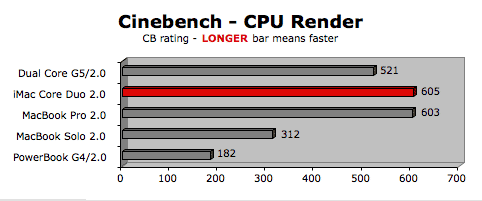
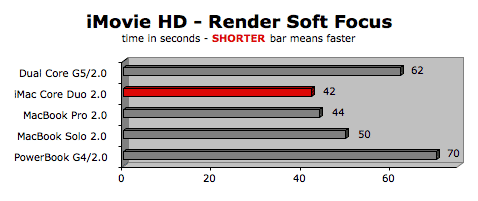
http://www.barefeats.com/pbcd.htmlApple MacBook Pro (2.0GHz Core 1 Duo)/Apple MacBook Solo (2.0GHz Core 1 Solo)
vs
Apple PowerBook (PowerPC 7447A 2.0GHz upgrade)
vs.
Apple Power Mac (Dual Core PowerPC 970 2.0Ghz)
We are not factoring Intel Core 2, AMD Phenom II and Intel Core i3/i5/i7 based PCs. AMD Bulldozer is already in engineering release mode i.e. same state as X1000 beta test.
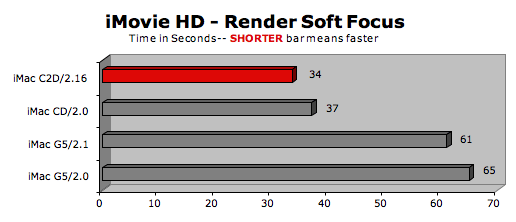
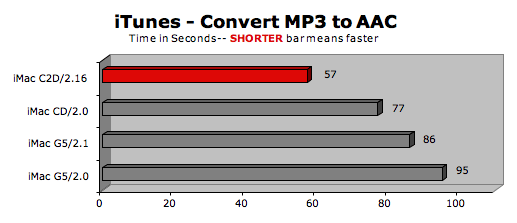
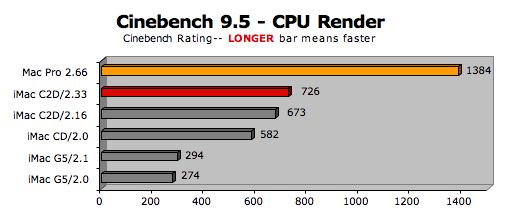
http://www.barefeats.com/imcd3.htmliMac C2D/2.33 = 24" iMac Core 2 Duo 2.33GHz
iMac C2D/2.16 = 20" iMac Core 2 Duo 2.16GHz
iMac CD/2.0 = Jan 2006 - 20" iMac Core Duo 2.0GHz
iMac G5/2.1 = Oct 2005 - 20" iMac G5/2.1GHz 'iSight'
iMac G5/2.0 = May 2005 - 20" iMac G5/2.0GHz 'ALS'
(All test systems had 2GB of memory)
 http://www.barefeats.com/g4up2.html
MAXPower G4/7448 Upgrade versus similarly clocked Macs
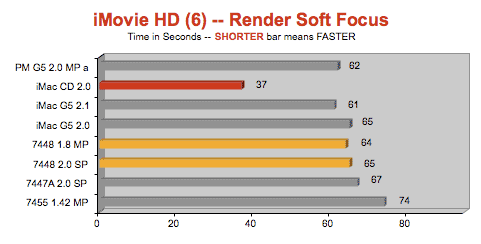
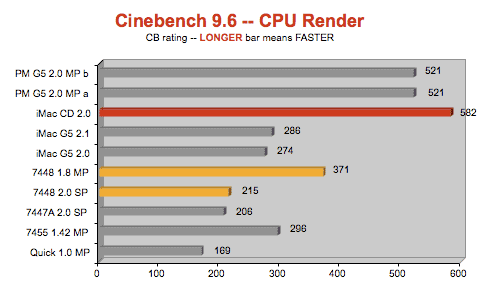
PM G5 2.0 MP b = Power Mac G5/2.0GHz "June 2003" with Radeon X800 XT
PM G5 2.0 MP a = Power Mac G5/2.0GHz "June 2003" with Radeon 9800 Pro SE
iMac CD 2.0 = Intel iMac Core Duo 2.0GHz with Radeon X1600
iMac G5 2.1 = iMac (Solo) G5/2.1GHz "iSight" with Radeon X1600 XT
iMac G5 2.0 = iMac G5/2.0GHz "ALS" with X1600 XTz
7448 1.8 MP = MAXPower Dual G4/1.8GHz 7448 Upgrade in a "QuickSilver 2002" Power Mac with Radeon 9800 Pro
7448 2.0 SP = MAXPower Solo G4/2.0GHz 7448 Upgrade in a "QuickSilver 2002" Power Mac with Radeon 9800 Pro
7447A 2.0 SP = GigaDesigns Solo G4/2.0GHz 7447A Upgrade in a "QuickSilver" Power Mac with Radeon 9800 Pro
7455 1.42 MP = Dual G4/1.42GHz 7455 "FW800" Power Mac with Radeon 9800 Pro
Quick 1.0 MP = Power Mac Dual G4/1.0GHz "QuickSilver 2002" with Radeon 9800 Pro
Quiick 800 MP = Power Mac Dual G4/800MHz "QuickSilver" with Radeon 9800 Pro
The G4 Power Macs had 1.5GB of RAM; The other Macs had either 1.5 or 2GB of RAM.
All Macs were running OS X 10.4.9.
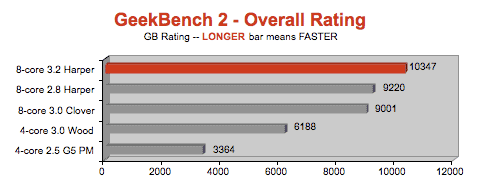
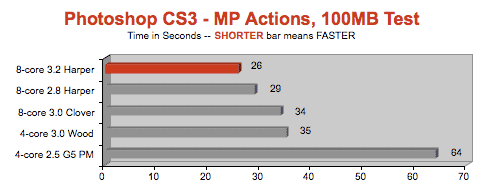
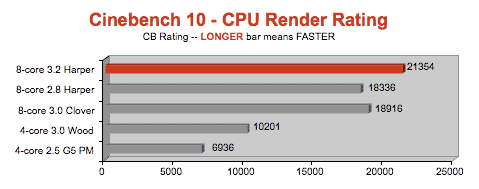
 http://www.barefeats.com/harper.html
Mac Pro 3.2GHz 'Harpertown' versus other Mac towers
Harper = "early 2008" Mac Pro "Harpertown"
Clover = "apr 2007" Mac Pro "Clovertown"
Wood = "aug 2006" Mac Pro "Woodcrest"
PM = Power Mac (last version with PCIe slots)
64bit GEEKBENCH 2 benchmark test on all Macs